SAT Math Formula Sheet — Every Formula You Need
Which formulas are given on the test, which you must memorize, and how often each appears — with worked SAT examples.
The Digital SAT provides a 15-formula geometry reference sheet at the start of every math section — circles, special triangles, volumes. Everything else (algebra, quadratics, statistics, exponents, trigonometry) you need to memorize. This guide covers every formula that actually appears on the test, ordered by frequency, with notes from real exam data.
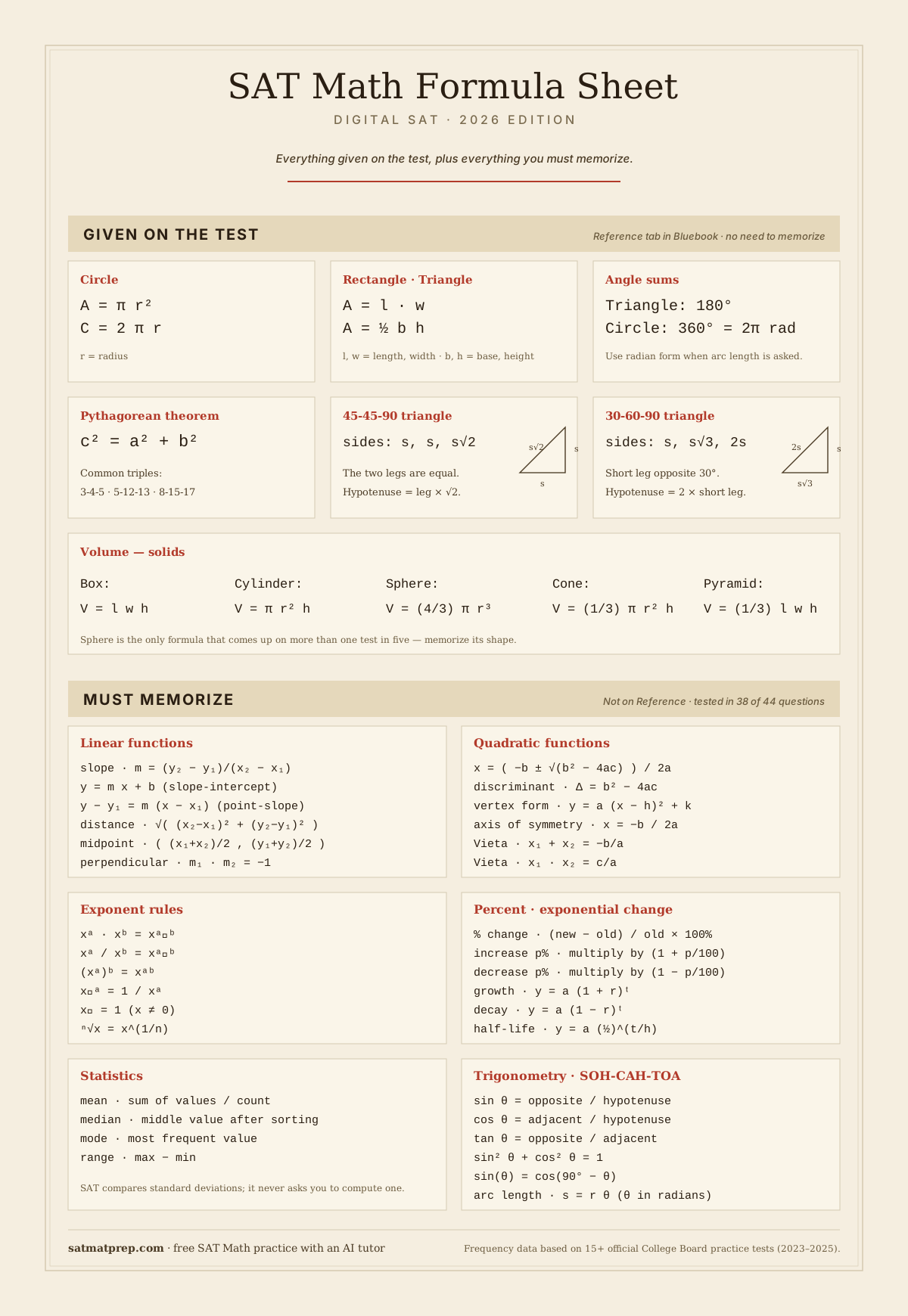
Formulas given on the test — the Reference sheet
Here's the exact list College Board shows in the Reference tab in Bluebook. You don't need to memorize these, but you do need to apply them fast — switching between the tab and the question wastes seconds.
| Category | Formula | Where it shows up |
|---|---|---|
| Circle — area | A = πr² | Sector area, bounded regions |
| Circle — circumference | C = 2πr | Arc length (fraction of 2πr) |
| Rectangle — area | A = lw | Physical-dimension word problems |
| Triangle — area | A = ½bh | Coordinate-plane triangles |
| Pythagorean theorem | c² = a² + b² | Right triangles, distance |
| 45-45-90 triangle | sides: s, s, s√2 | Square diagonal, right isosceles |
| 30-60-90 triangle | sides: s, s√3, 2s | Equilateral cut in half |
| Rectangular box | V = lwh | Box volume |
| Cylinder | V = πr²h | Cans, columns, cylinders |
| Sphere | V = (4/3)πr³ | Balls, planets |
| Cone | V = (1/3)πr²h | Rare, but appears |
| Pyramid | V = (1/3)lwh | Rectangular pyramids |
| Triangle angles sum | 180° | Find missing angle |
| Circle degrees | 360° | Sectors, central angles |
| Circle radians | 2π | Degree ↔ radian conversion |
Formulas you must memorize
Everything else. The SAT tests these formulas in 38 of the 44 math questions, so mastering them is a prerequisite for a 700+ score.
Linear functions (most heavily tested)
| Name | Formula |
|---|---|
| Slope | m = (y₂ − y₁)/(x₂ − x₁) |
| Slope-intercept form | y = mx + b |
| Point-slope form | y − y₁ = m(x − x₁) |
| Standard form | Ax + By = C |
| Distance formula | d = √((x₂−x₁)² + (y₂−y₁)²) |
| Midpoint formula | M = ((x₁+x₂)/2, (y₁+y₂)/2) |
| Parallel lines | equal slopes: m₁ = m₂ |
| Perpendicular lines | m₁ · m₂ = −1 (negative reciprocal) |
Quadratic functions
| Name | Formula |
|---|---|
| Quadratic formula | x = (−b ± √(b² − 4ac))/(2a) |
| Discriminant | Δ = b² − 4ac |
| Vertex form | y = a(x − h)² + k, vertex at (h, k) |
| Axis of symmetry | x = −b/(2a) |
| Sum of roots (Vieta) | x₁ + x₂ = −b/a |
| Product of roots | x₁ · x₂ = c/a |
| Difference of squares | a² − b² = (a − b)(a + b) |
Exponents and roots
| Rule | Formula |
|---|---|
| Product of powers | xᵃ · xᵇ = xᵃ⁺ᵇ |
| Quotient of powers | xᵃ / xᵇ = xᵃ⁻ᵇ |
| Power of a power | (xᵃ)ᵇ = xᵃᵇ |
| Negative exponent | x⁻ᵃ = 1/xᵃ |
| Zero exponent | x⁰ = 1 (x ≠ 0) |
| Fractional exponent | ⁿ√x = x^(1/n) |
Percentages and exponential growth
| Name | Formula |
|---|---|
| Percent change | ((new − old)/old) × 100% |
| Increase by p% | multiply by (1 + p/100) |
| Decrease by p% | multiply by (1 − p/100) |
| Exponential growth | y = a(1 + r)ᵗ |
| Exponential decay | y = a(1 − r)ᵗ |
| Half-life | y = a(1/2)^(t/h) |
Statistics
| Measure | Formula / definition |
|---|---|
| Mean | sum of values / count |
| Median | middle value when sorted |
| Mode | most frequent value |
| Range | max − min |
| Standard deviation | spread measure (SAT compares, doesn't compute) |
Trigonometry
| Name | Formula |
|---|---|
| SOH-CAH-TOA | sin=opp/hyp, cos=adj/hyp, tan=opp/adj |
| Pythagorean identity | sin²θ + cos²θ = 1 |
| Complementary angles | sin(θ) = cos(90° − θ) |
| Arc length (radians) | s = r · θ |
| Sector area | A = (θ/360) · πr² (θ in degrees) |
Frequency ranking — what to study first
Not every formula shows up equally often. This table estimates questions per test based on 15+ official College Board practice tests from 2023–2025.
| Formula | Questions per test | Study priority |
|---|---|---|
| Slope formula | 5–7 | Critical |
| Percent change | 3–5 | Critical |
| Exponent rules | 3–4 | Critical |
| Systems of equations (substitution) | 3–4 | Critical |
| Quadratic formula + discriminant | 2–3 | High |
| Vertex form of parabola | 2–3 | High |
| Exponential growth/decay | 2 | High |
| Mean and median | 2 | High |
| Pythagorean / triples (3-4-5 etc.) | 1–2 | Medium |
| SOH-CAH-TOA | 1–2 | Medium |
| Special triangles (30-60-90) | 1 | Medium |
| Distance formula | 0–1 | Low |
| Midpoint formula | 0–1 | Low |
Worked example — slope formula in action
Since slope is the most common formula, let's see how it appears in a typical SAT question.
Step-by-step solution:
- Slope of k: m_k = (13 − 5)/(6 − 2) = 8/4 = 2
- Slope of m (perpendicular): m_m = −1/2 (negative reciprocal)
- Point-slope form of m: y − 7 = −½(x − 4)
- Expand: y = −½x + 2 + 7 = −½x + 9
- y-intercept: 9
This question combines three formulas from the list (slope, perpendicular relationship, point-slope form) — exactly the kind of synthesis the SAT tests.
How to memorize efficiently — 4 rules
Grinding through 40 formulas with flashcards is inefficient. Data from our users shows this combination gets the best results:
- Don't memorize anything on the Reference sheet. Check it during the test without shame — the 5 minutes you save should go into the algebra formulas you MUST know.
- Derive, don't just repeat. The distance formula is the Pythagorean theorem in disguise. Vertex form is standard form after completing the square. Understanding derivations gives durable memory.
- Learn in context. You'll remember a formula faster after using it in 5 questions than after 20 flashcard reps. Our diagnostic test shows which formulas aren't yet stuck.
- Spaced repetition. Review the formula list on days 1, 3, 7, 14. Day-one cramming with nothing after is a guarantee you'll forget it in a week.
Common formula mistakes on the SAT
- Confusing standard form with slope-intercept form. In "line of the form Ax + By = C", slope is −A/B, not A/B. This mistake costs weak preppers 2–3 questions per test.
- Dropping the minus sign in perpendicular slopes. Perpendicular slopes are negative reciprocals, not just reciprocals. If m₁ = 3/4, then m₂ = −4/3, not 4/3.
- Mixing degrees and radians. The formula s = rθ needs θ in radians. A = (θ/360)·πr² needs θ in degrees. Confusing units gives an answer ~57× too large or too small.
- Memorizing Heron's formula. It's not on the SAT. Neither is the law of sines, law of cosines, or sum-of-angles identities.
Related resources
- SAT Linear Functions — complete guide
- Non-Linear Functions — quadratics, exponentials, absolute value
- Geometry and Trigonometry on the SAT
- SAT vs Polish Matura — math section comparison
Sources:
- College Board — official SAT site
- Bluebook — Digital SAT testing environment
- Digital SAT Test Specifications (PDF)
FAQ
Is the SAT formula sheet the same on the digital and paper tests?
Yes. Both the Digital SAT and the (rare) paper version give the exact same 15-formula geometry reference at the start of every math section. The only difference is presentation — in Bluebook (Digital SAT) you tap a Reference tab; on paper the formulas are printed on the booklet cover.
Which formulas are NOT given on SAT Math?
Everything except geometry. You need to memorize: the quadratic formula, discriminant, vertex form, slope and y-intercept, distance and midpoint formulas, exponent and logarithm rules, percent change, statistics basics (mean, median), and core trig (SOH-CAH-TOA and sin²+cos²=1). About 25 formulas total.
Can I bring my own formula sheet to the SAT?
No. The SAT prohibits any external notes, cheat sheets, or formula cards. The only tools available are the built-in Desmos calculator and the Reference tab in Bluebook. Bringing outside materials results in score cancellation.
Which formula appears most often on SAT Math?
The slope formula: m = (y₂ − y₁)/(x₂ − x₁). It shows up in 5–7 questions per test — sometimes directly, often as part of larger problems (perpendicular lines, intersections, linear models in context). Second most common: the quadratic formula x = (−b ± √(b² − 4ac))/(2a), averaging 2–3 questions per test.
Do I need to know all the trig identities?
No. You only need three: SOH-CAH-TOA (sin = opp/hyp, cos = adj/hyp, tan = opp/adj), the Pythagorean identity sin²θ + cos²θ = 1, and the complementary-angle relationship sin(θ) = cos(90° − θ). Sum-angle formulas, double-angle formulas, and sec/csc/cot identities are NOT tested on the SAT.
How many SAT Math questions come from geometry?
About 6 out of 44 (~14%). Geometry is the smallest domain — dominated by standard figures (circles, right triangles, rectangular solids) and the special triangles 30-60-90 and 45-45-90. Since those formulas are on the Reference sheet, geometry is often the easiest source of points on the test.